

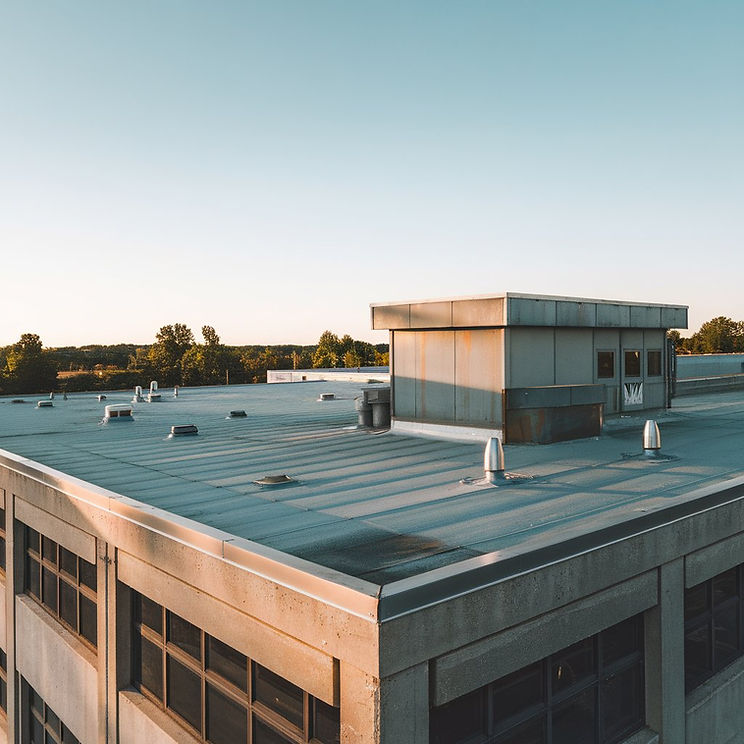
FLAT ROOFING SPECIALISTS
Torch On Roofing in Toronto for Commercial & Industrial Flat Roofs
Torch-on roofing is the heat-welded, multi-ply membrane that protects more commercial and industrial flat roofs than any other system — and it's the one Crown Industrial Roofing has installed, torched down, and repaired more than any other in nearly 50 years. Also known as modified bitumen or SBS roofing, this system fuses reinforced asphalt sheets directly to the roof with an open flame, creating seams that are welded rather than glued. If you manage a warehouse, plant, plaza, school, or multi-tenant industrial building, there's a strong chance your roof is a modified bitumen system already — and a strong chance it's the right call for your next one.
We install two-ply and three-ply SBS systems — torch-applied, cold-applied, and self-adhered — for commercial buildings across Toronto and the GTA's commercial roofing market. This page explains what torch-on roofing is, how it's installed, how long it lasts, what it costs to consider, and when it's the best flat roof system for your building — and when it isn't.
What is torch-on roofing?


It's a method of installing modified bitumen membrane. The membrane itself is asphalt that has been engineered, or "modified," with polymers to make it flexible, tough, and far more forgiving of temperature swings than the old tar-and-gravel built-up roofs it replaced. During installation, a roofer uses a propane torch to heat the underside of each sheet, melting the asphalt just enough to bond it to the layer below as it's rolled out. The result is a fully adhered, monolithic flat roof with heat-welded seams.
Because the word "torch-on" describes the application method, it's used interchangeably with "modified bitumen" and "SBS roofing." When a property manager asks for a torch-on roof, a modified bitumen roof, or an SBS roof, they're almost always describing the same family of system.
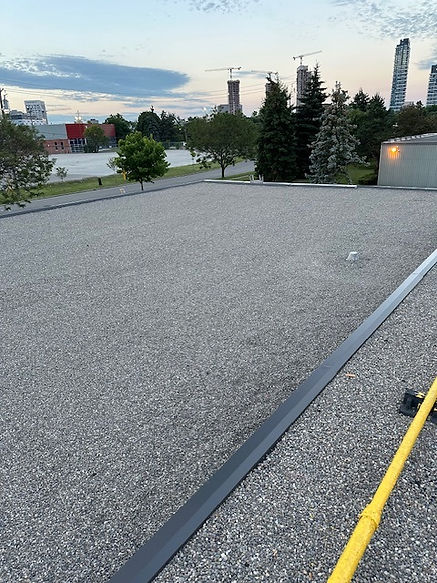
Torch-on vs torch-down: is there a difference?
Short answer: no. "Torch-on roofing" and "torch down roofing" are two names for the exact same thing — a modified bitumen membrane heat-welded into place with a torch. Some regions and crews say one, some say the other. Both refer to the flame-applied installation of SBS or APP modified bitumen sheets. If one bid says "torch down" and another says "modified bitumen", you're comparing the same system — which makes the rest of the quote (number of plies, membrane thickness, insulation, and warranty) the thing that actually matters.
SERVICES WE PROVIDE
Torch-On Roofing Services in Toronto
An SBS roof needs different work at different ages. Here's how we look after a modified bitumen roof from the day it goes on to the day it comes off, on commercial buildings across the GTA.
Flashing & Detail Work
Most leaks start at the edges, not the field: parapets, curbs, drains and penetrations. We rebuild and re-flash those details with compatible SBS membrane so the roof seals where it matters.

Torch-On vs Other Flat Roofing Systems
Torch-on isn't the right answer for every building. It's the system we specify most often on industrial roofs, but PVC is the better fit for some. Here's how SBS modified bitumen compares with the other membranes we work with.
Compared with TPO
TPO is a lighter, reflective single-ply membrane found on many newer GTA warehouses. We repair and service TPO roofs. When one needs replacing, we quote it in SBS, PVC or built-up roofing.
Compared with EPDM
EPDM is a rubber sheet that's been on Toronto roofs for decades. It handles cold well, but seams and terminations pull apart as it ages. We repair EPDM, and when it's done, we replace it with SBS, PVC or built-up.
2-Ply vs 3-Ply Systems
A 2-ply system (base sheet plus granulated cap sheet) is the standard on most commercial roofs. A 3-ply build adds a layer for heavy traffic or where current insulation code pushes the assembly heavier. We'll tell you which one your building needs.
Weighing torch-on against another system? That's exactly what we walk clients through during an inspection. For lifespan, common failures and 2026 costs, read our guide to SBS modified bitumen problems in Toronto.
Built for Commercial & Industrial Properties
We don't do residential. For 50 years every roof we've worked on has been commercial or industrial, and torch-on modified bitumen has been the system on more of them than any other. Here's how it plays out on the buildings we work on every week.
Warehouses & Distribution Centres
We've worked on warehouse roofs over 50,000 sq ft, where one bad drain turns into an operations problem. SBS handles the foot traffic and rooftop units, and we phase the work so your facility keeps running.
Retail Plazas
Plazas mean multiple tenants, multiple drains and rooftop units over every storefront. The membrane stands up to that equipment traffic, and we schedule the work with property managers so no tenant is surprised by a crew on the roof.
Office Buildings
Tenants stay at their desks. We schedule torch work around them and keep disruption low from set-up to clean-up.
Condominiums
Condo boards need documentation, guarantees, and accountability. We provide all three - including detailed post-inspection reports that satisfy both board requirements and reserve fund studies. We also handle building envelope caulking and sealing for condominiums as part of a complete property care approach.Condo boards need documentation, guarantees and accountability. We provide all three, including detailed post-inspection reports that satisfy board requirements and reserve fund studies. We also handle building envelope caulking and sealing for condominiums.
Industrial Facilities
Chemical exposure, heavy equipment and constant maintenance traffic. SBS takes punctures and foot traffic better than most membranes, which is why it's the system we specify most often on industrial facilities.

Serving Toronto, Etobicoke & the GTA
We operate across the full city and surrounding regions - including:
Toronto: North York, Etobicoke, Scarborough, East York, Downtown Core, York
GTA: Mississauga, Brampton, Vaughan, Markham, Richmond Hill, Pickering, Oshawa, Oakville, Hamilton, Barrie
We also understand how Toronto's climate impacts commercial roofs specifically - from freeze-thaw cycles in winter to heavy rainfall in spring and summer. These conditions are a big reason why service frequency and proper system selection matter here more than they do in milder regions. A roofing decision that works fine in Vancouver can underperform badly on a Toronto warehouse roof after two hard winters.
If you're not sure whether we service your area, just call. Chances are our roofing crews have handled jobs nearby.
Our Installation Process
We've refined this over 50 years. It isn't complicated, but it removes the guesswork building owners usually dread.
Roof Inspection - We get up on the roof, take core samples where needed and run an infrared scan if moisture is suspected, so we know what's under the membrane before we quote.
Assessment & Report - You get a written report: membrane and deck condition, drainage, problem areas, and our honest recommendation on repair vs. replacement.
Transparent Quote - Line-item pricing, including the number of plies, insulation and flashing details. You'll know what you're paying for before anything gets signed.
Installation - Our own crews, not subcontractors, tear off, prepare the deck, install insulation and torch down the base and cap sheets, then re-flash every edge and penetration.
Final Inspection & Warranty - We walk the roof with you before we close the job. Warranties on materials and workmanship are provided in writing.

Torch-On Roofing Cost in Toronto
This is the part where most roofers go vague. We'll give you real numbers, with the caveat that every roof is different. These ranges reflect commercial SBS projects across the GTA, not generic estimates.

What affects the cost:
Size - larger square footage means more material and labour.
Number of plies - a 3-ply build costs more than a standard 2-ply system.
Deck condition - if the deck underneath is compromised, that adds to the scope.
Insulation - tapered insulation for drainage and current code requirements adds cost.
Flashing and access - parapets, curbs, rooftop equipment and active tenants all affect timeline and cost.
Ballpark ranges for context (Toronto market, 2026):
A fully specified 2-ply SBS system with tear-off and tapered insulation generally lands between $8 and $14 per square foot installed. A heavier 3-ply system built to current insulation code can push toward $20 per square foot. Repairs can start in the low thousands.
We're not going to pretend a number on a website is accurate for your building. What we will do is give you a proper, itemized quote at no obligation.

Why Choose Crown Industrial Roofing
There's no shortage of contractors in Toronto. Here's what actually separates us.
50 years of commercial-only experience. We've never offered residential roofing services. Every job we've ever taken has been commercial or industrial - which means every decision we make is informed by that specific context.
No subcontractors. Our crews are our crews. That's how we maintain quality control on every project, regardless of size.
A documented process. From inspection to final sign-off, you'll know exactly where things stand at every stage. No surprises, no chasing invoices for clarity.
Long-term client relationships. A lot of our repeat business comes from property managers and building owners who've been calling us for years - some for decades. That kind of loyalty doesn't happen if the results don't hold up.
Honest assessments. If your roof doesn't need replacing, we'll tell you that. If it does, we'll show you exactly why. We'd rather keep a client for 20 years than oversell a job once.

Frequently Asked Questions
Q: How long does a torch-on roof last?
Manufacturers quote 20 to 30 years. On a real GTA roof with foot traffic, ponding and Toronto winters, the honest number is closer to 15 to 20 years for a 2-ply system, assuming a good installation and basic maintenance. Drainage and seam quality make the biggest difference.
Q: Is it safe to torch a roof on an occupied building?
Yes, when it's managed properly. Torch-applied installation uses an open flame, so it's a real risk that has to be managed, not ignored. Ask any contractor for their fire watch protocol in writing. Where an insurer or building won't allow torches, cold-applied and self-adhered SBS systems are an option.
Q: Should I repair or replace my modified bitumen roof?
It depends on where the damage is, not just how much. Localized seam failures, punctures and small blisters are usually repairable. Widespread granule loss, blistering in several areas, or chronic ponding on a roof past 18 to 20 years usually means replacement costs less over the next few years than repeated repairs.
Q: Is SBS a good fit for Toronto's climate?
Yes. The SBS rubber modifier keeps the membrane flexible in the cold, which is why it holds up through freeze-thaw cycles. That, plus its track record and puncture resistance, is why 2-ply SBS is still the dominant commercial flat roof system in the GTA.
Q: Do you work with property managers and condo boards?
Yes, regularly. We're comfortable providing the documentation, reporting, and communication that property management situations require.
Get a Flat Roof Quote in Toronto
If you're even slightly unsure about the condition of your roof, it's worth getting it looked at before the next season changes things.
If you've got a commercial or industrial building in Toronto and you're not sure what's going on with your roof - or you already know something needs to be done - this is the easiest next step.
No obligation. No hard sell. Just an honest assessment from a contractor that's been doing this for 50+ years.
Crown Industrial Roofing - Toronto's Commercial Flat Roof Specialists since 1976.